How to choose a desktop AI agent for real work
A desktop AI agent should do more than answer prompts: it needs clear file permissions, a workspace for non-code work, a separate path for repositories, controllable model costs and an honest local-to-cloud boundary. Use this checklist to evaluate one.
The More AI team · Updated September 12, 2026
What a desktop AI agent actually is
A desktop AI agent is an application that can plan and carry out multi-step work on your computer with tools you explicitly allow. Unlike a browser chat, its useful output may be a changed file, a tested code diff or a scheduled result—not only text in a message.
The important word is not “AI” but “agent”: it can inspect context, choose a next step, use a tool and check the result. A good desktop agent makes every boundary visible, especially which folder it can reach, which commands it may run and when work moves from your computer to a cloud environment.
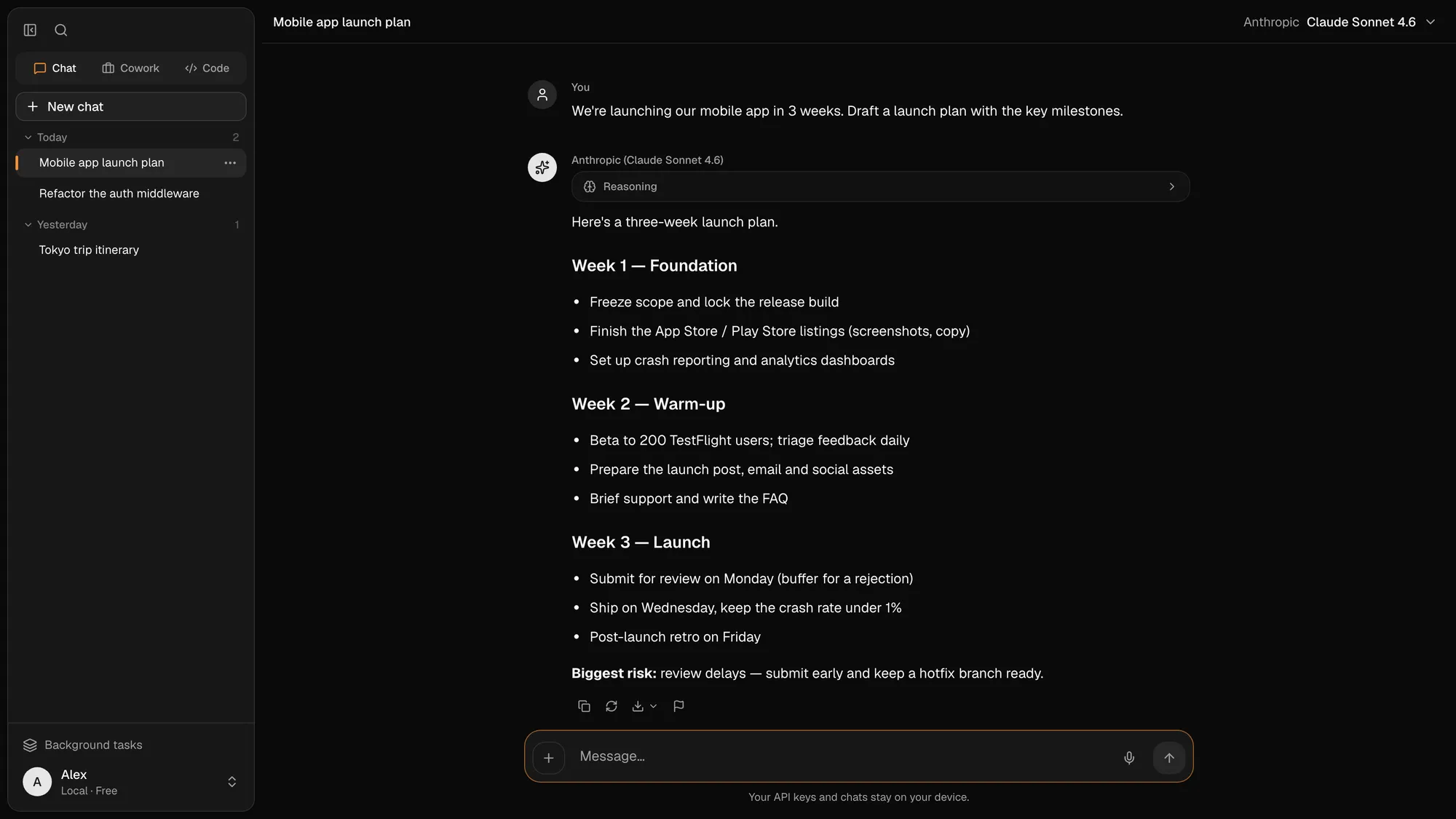
1. Match the workspace to the deliverable
Start by naming the deliverable. Knowledge work needs a workspace that understands ordinary files and can produce documents, spreadsheets, presentations or research notes. Software work needs repository awareness, diffs, commands, tests and git history. Treating both as one generic chat usually hides the permissions that matter.
In More AI, Cowork is the default for questions and general file work; Code is separate for repositories. This section is about choosing the boundary, not configuring a project—the dedicated Cowork and Code guides cover those workflows step by step.
- Ask whether a conversation can grow into a file task without starting over.
- Check whether repository tools are isolated from ordinary document work.
- Verify that edits and command results are reviewable before you accept them.
2. Understand local, provider and cloud boundaries
“Desktop” does not automatically mean “offline.” An online model receives the prompt and selected context at its provider. For prompts and inference to stay on the machine, use a local model and turn off sync, web/cloud tools, master telemetry and AI observability including replay.
Before choosing a product, map one realistic task: where is the conversation stored, which files are uploaded, who receives the prompt, and what changes when sync is enabled? Prefer a product that describes these states separately instead of using an absolute privacy slogan.
3. Check who controls models and token spend
A fixed AI subscription and bring-your-own-key solve different problems. BYOK lets you choose the provider and model and pay that provider for actual token use; a platform subscription can fund execution, synchronization and access from other devices. A transparent product separates those two bills.
For evaluation, confirm that you can see the active provider, change models by task and set provider-side spending limits. More AI supports provider keys and local OpenAI-compatible endpoints; its dedicated BYOK guide covers key setup and cost controls in detail, so this guide keeps the point to the decision itself.
4. Decide whether work must continue away from the laptop
A purely local agent stops when its computer sleeps or loses power. That is often the right trade-off for sensitive, hands-on work. If you need a routine to run overnight or want to follow a task from a browser or phone, look for explicit cloud execution—not just a synced transcript.
Cloud continuity means the task runs in a hosted environment and the result appears on signed-in surfaces. It requires an account and has a different data boundary from local work. Web access works today; the Android APK is in private development testing, while iOS is limited to development and simulator testing with no distribution signing, TestFlight or device release.
5. Inspect permissions, evidence and recovery
The best model is not a substitute for control. A desktop AI agent should show what it read, what it changed and whether a command succeeded. It should distinguish read-only access from edits, pause on gated actions, and leave artifacts you can inspect outside the conversation.
Also test failure recovery. Close the window during a long operation, interrupt the network and reopen the task. For cloud work, verify whether the run continues and can be reattached. For local work, verify that partial edits remain visible and reversible rather than being silently presented as complete.
- Scoped folder or repository access
- Visible plan, tool activity and file diffs
- Separate permissions for reading, editing and commands
- Clear stopped, failed and completed states
- Exportable files and a recoverable conversation history
A 20-minute hands-on evaluation
Use the same small task in every product you compare. A useful test is to give the agent three notes, ask for a one-page brief, request one revision and then ask where the output was saved. For a coding agent, use a disposable repository, request one bounded change and require it to run the relevant test.
- Choose the cheapest suitable model and note how clearly the product shows that choice.
- Grant access to one disposable folder or repository, not your whole home directory.
- Ask for a plan and watch which tools and files the agent actually uses.
- Change one requirement halfway through and check whether the result stays coherent.
- Review the artifact, diff or test output outside the assistant’s prose.
- Repeat through the cloud path only if cross-device continuity is part of your requirement.
Where More AI fits—and where it does not
More AI fits people who want a free desktop application, control over model choice and token spend, Cowork for general work, and Code for repositories. Local desktop use does not require an account. The optional cloud layer adds server-run tasks, synchronization and access from web and other devices; during the current beta it is temporarily free, with advance notice promised before billing starts.
It is not a fully offline tool with an online provider, and parts of cloud Code remain in beta. Mobile status differs by platform: the Android APK is in private development testing; iOS has development and simulator testing only, with no distribution signing, TestFlight or device release.
Frequently asked questions
What is the difference between a desktop AI assistant and an agent?
An assistant mainly returns an answer. An agent can plan steps, use allowed tools, work with files or a repository and check an artifact or command result. The product should still expose those actions for review.
Does a desktop AI agent keep all data offline?
Not necessarily. Online models receive prompts and context, while sync and cloud execution send required data. For a local boundary, use a local model and turn off sync, online tools, master telemetry and AI observability including replay.
Should I use Cowork or Code?
Use Cowork for questions, research, documents and ordinary files. Use Code when the output is a repository change that should be reviewed with diffs, commands, tests and git context.
Do I need my own API key?
A provider key gives you direct control over model selection and token spending. More AI supports that path, as well as local compatible endpoints; availability of pooled or cloud options can depend on the current entitlement and beta rollout.
When is cloud execution worth it?
Use it when a task must continue after the laptop closes, run on a schedule or be followed from another device. Keep the task local when hands-on control or the smallest data boundary matters more.
How is More AI cloud priced?
Cloud is the subscription layer, while the desktop app remains free and tokens stay on your provider key. During the current beta, cloud features are temporarily available free and More AI says it will give advance notice before billing begins.